How to Get Honest Feedback on Your Singing Without a Teacher
October 29, 2026
Most people who sing at home never find out how they actually sound. Friends say "that was lovely", which is kind and tells you nothing. A teacher would tell you the truth, but a weekly lesson is expensive, and many singers are not ready to sing in front of one yet. Here is a way to get specific, honest feedback on a song you have already practised, using nothing but your phone.
Step 1: Record the song you want to improve
Pick one song, ideally one you already know well. Record it in a quiet room, holding the phone at about arm's length. In SurSetu you can record or upload audio or video that runs from 20 seconds up to 5 minutes, so a single verse and chorus is plenty. Choose the language and style of the song, such as Hindi playback or a classical bandish, so the feedback is judged against the right kind of singing.
Step 2: Read the score as a map, not a verdict
A single number is only useful if it tells you where to look. SurSetu gives an overall score out of 100, a short label such as "Developing", and a box called "Focus on this next" that names the one thing that would help most right now.
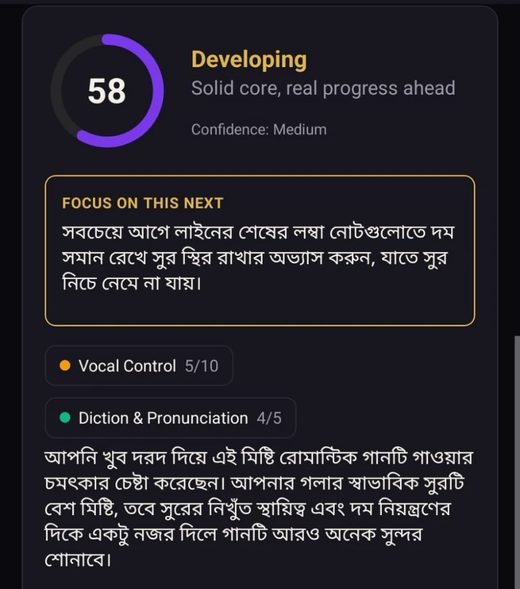
The feedback comes in the language you choose: English, Hindi, Telugu, Tamil, Marathi, Bengali or Punjabi. Advice about breath control lands better in the language you think in.
Step 3: Look at the category scores
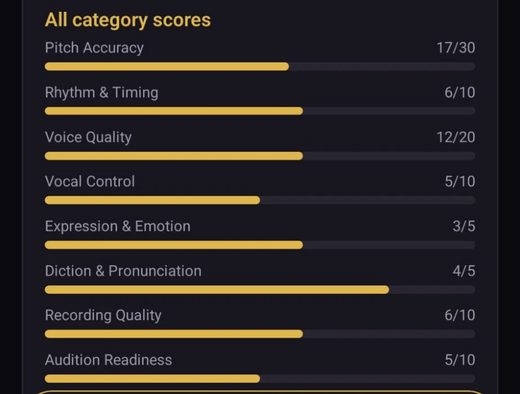
Underneath is a breakdown across eight areas: pitch accuracy, rhythm and timing, voice quality, vocal control, expression and emotion, diction and pronunciation, recording quality, and audition readiness. This is where a vague feeling that something is off becomes a specific answer, such as "my pitch is fine but my vocal control drops at the end of long notes".
Step 4: Replay the exact moments that need work
The most useful part is the list of specific moments. Each one gives a time range in your recording, the category it belongs to, a short explanation, and a Play button so you can hear that exact stretch again. Hearing yourself go flat on one particular long note teaches more than a general instruction to "work on pitch".
Step 5: Follow the practice plan and ask questions
Every evaluation ends with a short practice plan. If something is unclear, you can ask the AI teacher a follow-up question about your own performance, for example "why does my voice tire on the high lines?". Then sing the song again and compare. Improvement shows up when you repeat the same song a few days later, not when you jump to a new one.
What this will not replace
Software can measure pitch, timing and steadiness reliably. It cannot see your posture or judge how beautiful a phrase was. When you want that, a human guru is the right next step. We wrote about how to use both together in Can AI teach you to sing? and about the habits behind most off-key singing in how to sing in tune.
Record one song today and see which of the eight areas to work on first.
Get started free